New York,
New York,

I’m a product designer working where brand and design systems meet.

I’m a product designer working where brand and design systems meet.

Currently studying Design, AI and IXD @ Pratt Institute, NY.
Previously @Nike

Currently studying Design, AI and IXD @ Pratt Institute, NY.
Previously @Nike

Currently studying Design, AI, and IXD @ Pratt Institute, NY. Previously @Nike

Amazon Music Frequency onboarding screens showing identity-based music discovery.

Music discovery that starts with who you are: An identity-first personalization system for Amazon Music.

Music discovery that starts with who you are: An identity-first personalization system for Amazon Music.

Most music recommendation systems rely heavily on listening history. History tells you what someone has done. It says less about who they are, why they listen, or what they need right now.

Most music recommendation systems rely heavily on listening history. History tells you what someone has done. It says less about who they are, why they listen, or what they need right now.

For the Amazon Music × Pratt Product Design Challenge, my team and I asked a different question:

For the Amazon Music × Pratt Product Design Challenge, my team and I asked a different question:

What if discovery started with how someone relates to music?

What if discovery started with how someone relates to music?

BRIEF.TXT

BRIEF.TXT

The result was Frequency, a product concept exploring an identity-first approach to personalization. It gives new listeners a starting point for discovery before significant behavioral history exists, then proposes a way for that starting point to evolve as the listener’s relationship with music changes.

The result was Frequency, a product concept exploring an identity-first approach to personalization. It gives new listeners a starting point for discovery before significant behavioral history exists, then proposes a way for that starting point to evolve as the listener’s relationship with music changes.

01/ 
Scenario over prompt. The five questions use a real-life scenario so taste reads as mood, not genre. Keeps the cost of answering low at the start, where drop-off is highest.

02/ 
I paired a draggable record with a slider so onboarding feels like play. 'Tap an answer' stays as a fallback.

03/ 
Standard artist and genre selection follow the quiz. Kept familiar so the novel moment stays the quiz itself.

01/ Scenario over prompt. The five questions use a real-life scenario so taste reads as mood, not genre. Keeps the cost of answering low at the start, where drop-off is highest. 02/ I paired a draggable record with a slider so onboarding feels like play. 'Tap an answer' stays as a fallback. 03/ Standard artist and genre selection follow the quiz. Kept familiar so the novel moment stays the quiz itself.

01 / 05
01/ 
Scenario over prompt. The five questions use a real-life scenario so taste reads as mood, not genre. Keeps the cost of answering low at the start, where drop-off is highest.

02/ 
I paired a draggable record with a slider so onboarding feels like play. 'Tap an answer' stays as a fallback.

03/ 
Standard artist and genre selection follow the quiz. Kept familiar so the novel moment stays the quiz itself.

01/ Scenario over prompt. The five questions use a real-life scenario so taste reads as mood, not genre. Keeps the cost of answering low at the start, where drop-off is highest. 02/ I paired a draggable record with a slider so onboarding feels like play. 'Tap an answer' stays as a fallback. 03/ Standard artist and genre selection follow the quiz. Kept familiar so the novel moment stays the quiz itself.

01 / 05

Overview

Frequency explores how identity could become an additional signal for music personalization.

Rather than replacing behavioral recommendations, it layers an initial understanding of the listener on top of taste, then introduces emotional and long-term behavioral signals as the relationship develops.

It layers an initial understanding of the listener on top of taste, then introduces emotional and long-term behavioral signals as the relationship develops.

Role

Product Design — led framework, visual direction, and prototype

Product Design, led the concept, designed the system, and built the prototype

Team

4 designers
2 Amazon partners

Recognition

🏆 Winner, 2026 Amazon Music × Pratt Product Design Challenge

Timeline

3-week sprint

Overview

Frequency explores how identity could become an additional signal for music personalization.

Rather than replacing behavioral recommendations, it layers an initial understanding of the listener on top of taste, then introduces emotional and long-term behavioral signals as the relationship develops.

It layers an initial understanding of the listener on top of taste, then introduces emotional and long-term behavioral signals as the relationship develops.

Role

Product Design — led framework, visual direction, and prototype

Product Design, led the concept, designed the system, and built the prototype

Team

4 designers
2 Amazon partners

Recognition

🏆 Winner, 2026 Amazon Music × Pratt Product Design Challenge

Timeline

3-week sprint

Overview

Frequency explores how identity could become an additional signal for music personalization.

It layers an initial understanding of the listener on top of taste, then introduces emotional and long-term behavioral signals as the relationship develops.

Role

Product Design, led the concept, designed the system, and built the prototype

Team

4 designers
2 Amazon partners

Recognition

🏆 Winner, 2026 Amazon Music × Pratt Product Design Challenge

Timeline

3-week sprint

The Challenge

Personalization learns from the past.

New listeners arrive without history.

A new user opens the app with little listening data behind them. The system has limited evidence to personalize from at the moment the listener is deciding whether the service feels relevant to them.

COLD_START.TXT

Existing listeners change over time.

A listener may use music differently from one period of their life to another, while accumulated behavior continues to reflect what happened before.

DRIFT.TXT

Problem Statement

How might we make discovery feel personal before the system has significant listening history?

Problem Statement

How might we make discovery feel personal before the system has significant listening history?

Problem Statement

How might we make discovery feel personal before the system has significant listening history?

The Insight

Music taste comes from behavior, but music identity takes intention.

Listening history tells us what someone has played before. It doesn’t tell us what they’re looking for when they open the app today, or what role music plays for them in that moment.

Our research pointed to three dimensions that people use to describe their relationship with music beyond genre: Energy, Complexity, and Purpose.

That gave us a different starting point: if preference can exist beyond genre, could personalization exist beyond listening history?

Research participant

“The best music discoveries feel nice
when the app truly gets my taste.”

Research participant

“Sometimes I am not looking for
a song, I am looking for a vibe.”

Research participant

“I want each playlist to capture a
different side of who I am.”

Research participant

“Music often helps me make
sense of what I am feeling.”

Research participant

“My music library should feel like a
diary of my moods.”

Research participant

“The songs I save usually reflect what
I am experiencing at that moment.”

VOICES.RAW

The Model

From dimensions to identity.

We didn’t want to create eight personality types. We wanted a small set of starting states that could give the system enough signal to personalize without asking a new listener to define their entire taste.

We started with three dimensions from our research:

(soft ↔ hard)

How much intensity do I want?

ENERGY

(simple ↔ complex)

How much sonic depth do I enjoy?

COMPLEXITY

(self-reflection ↔ mood regulation)

What am I using music for?

PURPOSE

Each dimension has two poles. The resulting combinations create eight possible starting states, which we call Frequencies.

A Frequency is a lightweight starting hypothesis about how someone relates to music. It is designed to guide discovery before significant behavioral history exists, not to define the listener permanently.

MODEL.MAP

Traditional recommendation systems can ask:

“What have you listened to?”

Frequency explores a different question:

“What role does music play in your life?”

EIGHT FREQUENCIES

The System

Four layers that grow with the listener.

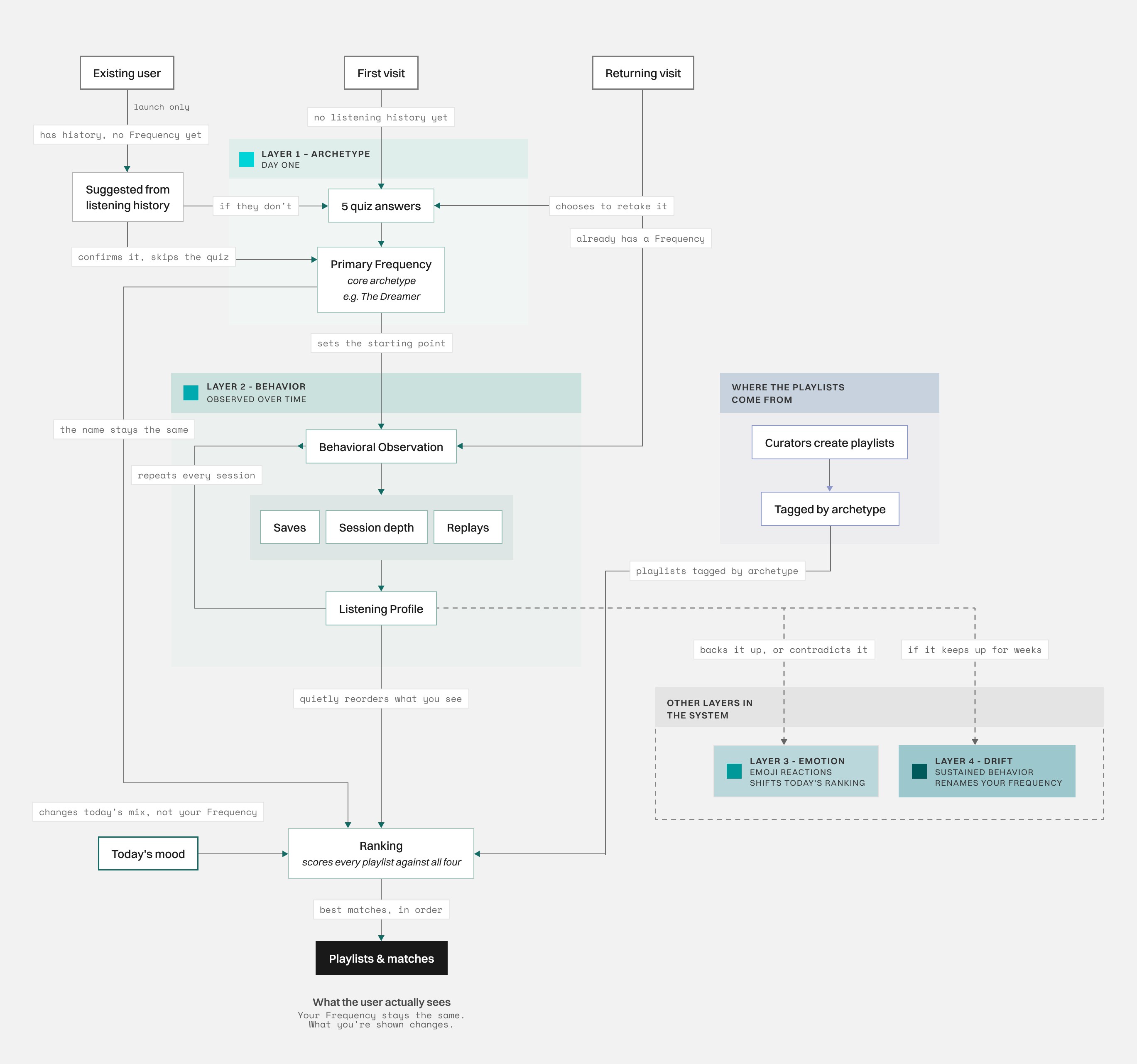
I designed Frequency as one conceptual personalization model with four inputs, each operating on a different timescale. The initial identity creates a starting point. Behavior refines it, emotion responds to the current moment and drift recognizes sustained change over time.

use + / - to zoom, drag to pan
Diagram
100%
use + / - to zoom, drag to pan
Diagram
100%

This is an interactive prototype
Try it!

01/ Starting Frequency

Personalization from day one. Traditional taste questions still provide useful signal, so we kept them and layered identity on top.

Instead of asking listeners to describe their taste abstractly, scenario-based prompts explore how they actually use music.

LAYER 01

02/ Behavior

Saves, skips, and replays provide ongoing behavioral evidence.

A listener’s behavior can gradually make the system more confident about what they tend to enjoy.

LAYER 02

03/ Emotion

A session has its own context. Behavior reveals what a listener tends to like. A session needs its own signal.

Seven lightweight reactions give listeners a way to communicate whether a session delivered the feeling they were looking for. In the prototype, that signal affects the current session rather than directly rewriting the listener’s identity.

LAYER 03

04/ Drift

Recognize change without overreacting to it.

Frequency separates temporary emotional state from sustained behavioral change. A single session can influence today’s recommendations, while a persistent pattern can gradually inform a change in the listener’s Frequency.

When the system detects sustained change, it proposes that the listener revisit their Frequency rather than silently changing it on their behalf.

The rule:
temporary states inform the moment; sustained patterns inform the identity.

LAYER 04

Principles

Two rules that kept it honest.

As the model became more complex, these rules helped keep Frequency from turning identity into a fixed label or emotion into permanent evidence.

Identity is not preference.

Artists and genres still carry meaningful signal. Frequency sits on top of taste rather than replacing it, giving behavioral preferences additional context within a broader understanding of the listener.

Artists and genres still carry meaningful signal. Frequency sits on top of taste rather than replacing it, giving behavioral preferences additional context within a broader understanding of the listener.

RULE.01

The listener stays in control.

Personalization should adapt without becoming invisible. When sustained change appears, Frequency proposes giving the listener a chance to acknowledge it rather than silently deciding who they’ve become.

Personalization should adapt without becoming invisible. When sustained change appears, Frequency proposes giving the listener a chance to acknowledge it rather than silently deciding who they’ve become.

RULE.02

Validation

Test the idea before testing the system.

A full personalization system would need long-term behavioral data to prove recommendation quality. A three-week sprint couldn’t produce that. Instead, we tested the assumption everything else depended on:

Would people want an app to understand their relationship with music, rather than only their listening history?

Validation results showing how participants recognized themselves in the listener Frequencies.

We returned to the six participants who had completed our concept survey and walked them through the prototype. All six participants responded positively to the scenario-based onboarding and described the experience as more personal than a traditional preference questionnaire.

RESULT.LOG

Revised validation flow incorporating participant feedback.

What we changed. Our first prompts asked people to describe their relationship with music directly, and participants struggled to answer. My teammate rewrote the prompts as real-life scenarios, and we tuned the language until it felt less like a personality test and more like a curious friend.

The revised prompts produced more natural responses and richer descriptions of how participants actually use music.

REVISION.LOG

Working with AI

Shortening the distance between idea and prototype.

Amazon provided brand guidelines and UI assets covering typography, spacing, color, and key screens. I used AI-assisted prototyping to translate those assets into working interfaces quickly, which let me spend more of the sprint exploring interactions instead of rebuilding established components.

The value was shortening the distance between an idea and something we could put in front of people. Working prototypes gave us something tangible to react to, test, and change while the underlying concept was still forming.

Outcome

A different starting point for personalization.

Frequency won the 2026 Amazon Music × Pratt Product Design Challenge.

In testing, participants responded positively to being understood through their relationship with music, and scenario-based onboarding gave them a more natural way to express that relationship.

Whether that understanding produces better discovery is the next thing to test.

Reflection

The hardest part was changing the question.

The biggest decision happened before a single screen existed. We started out trying to improve music discovery. Research and interviews pointed to a problem underneath: what someone listens to doesn’t fully explain what music is doing for them.

The project changed what I think personalization is for. The goal is earning trust while the system learns, letting the person stay in control of how they’re understood. That’s the instinct I want to keep bringing to product design: building systems that adapt to people without deciding who they are.

Come say hi.

Have a project, question, or just want to chat about typefaces? I’d love to hear from you.

© 2026 All rights reserved

THE GLYPH INDEX

Pilcrow Sign

AKA Paragraph mark

Come say hi.

Have a project, question, or just want to chat about typefaces? I’d love to hear from you.

© 2026 All rights reserved

THE GLYPH INDEX

Pilcrow Sign

AKA Paragraph mark

Come say hi.

Have a project, question, or just want to chat about typefaces? I’d love to hear from you.

THE GLYPH INDEX

Pilcrow Sign

AKA Paragraph mark